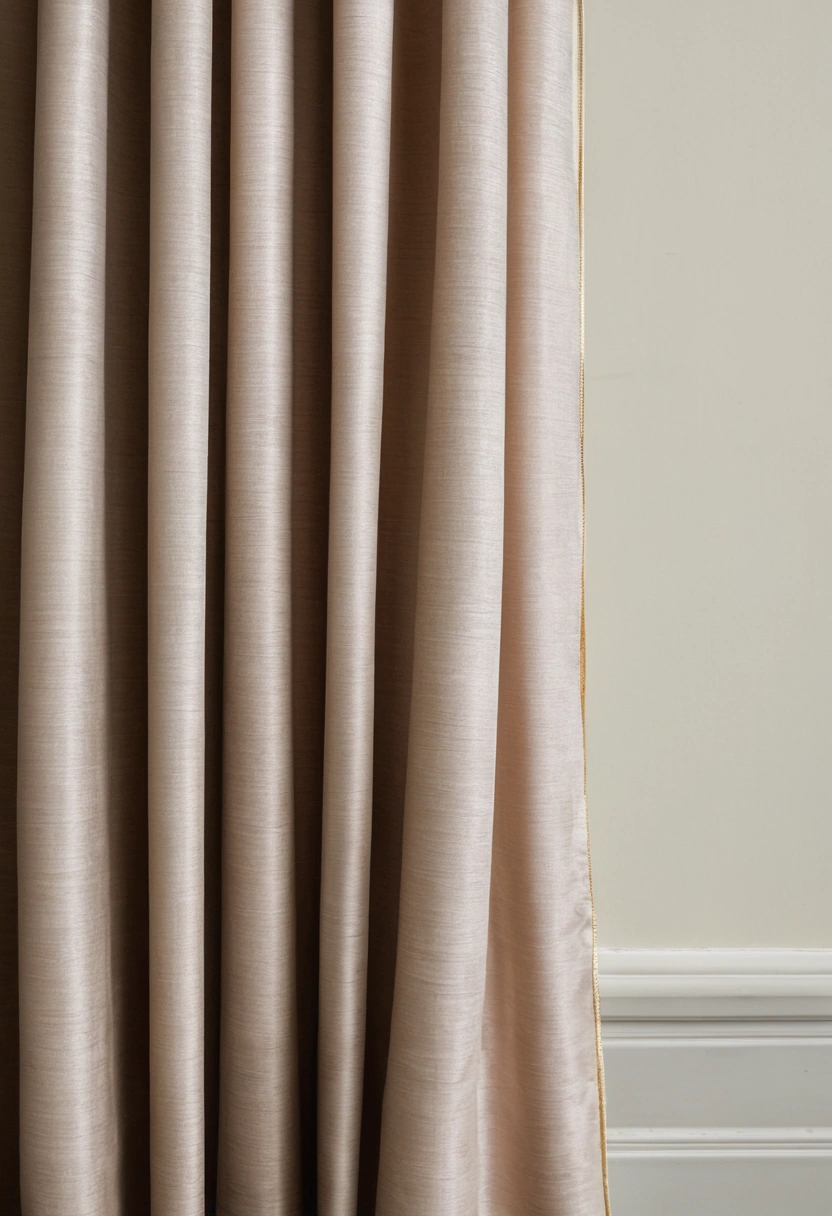
A curtain lining has several possible jobs, and the correct one depends on the window. Sarelli Textiles is an Italian manufacturer of furnishing fabrics and sheer curtains. The useful decision is whether the room needs softer daylight, nighttime privacy, protection for the face fabric, or a combination of those functions.
A fabric sample held in a showroom is rarely seen under the same backlight as a finished curtain. Hold the proposed face fabric against the actual glass. View it from inside during the day and from outside after the interior lights are on. Those two observations can produce opposite privacy judgments. Lining should be chosen in response to the measured problem, not merely because a heavier curtain sounds more complete.
In a period room, check the proposed track and lining against retained cornices, window shutters, and deep reveals. The curtain should be measured around those existing details. A standard installation drawing may miss the clearance needed to operate a shutter or preserve access to the window handle.
How does a lining change light at a window?
A lining changes the amount, direction, and color of light passing through the curtain assembly. An unlined sheer transmits substantial daylight and offers a view of its weave. A lined drape can block more light through the fabric, while gaps at the top, side, and center may still admit light. A darkening requirement therefore concerns both fabric and installation geometry.
Test the full assembly rather than an isolated swatch. Place a lining sample behind the face cloth in the intended order and hold both against the window. Look for show-through, altered color, and a shadow from the lining seam. A pale lining can make a face cloth appear cleaner from the street; a darker lining may change the perceived shade when backlit. Neither effect can be reliably inferred from an online color chip.
The Australian government’s household window guidance recommends close-fitting lined curtains or blinds as part of temperature control. That advice addresses the whole covering, including fit. It does not mean every lining provides the same thermal or light effect. Material, color, coverage, and use schedule matter.
What is the difference between daytime and nighttime privacy?
Daytime privacy and nighttime privacy must be tested under different light directions. During daylight, a sheer may obscure detail when the exterior is brighter than the room, yet remain transparent from certain angles. At night, interior lighting can silhouette people and furniture against a bright room. A sample that appears private in daylight cannot be approved for nighttime privacy without a night test.
Walk outside to the usual viewing positions after dark, with the room lit as it normally will be. Check the center overlap, side returns, and the lower edge as well as the fabric field. If a second layer is planned, test whether it can be closed without pulling against handles or furniture. A room that needs a daytime view and nighttime privacy may work better with a sheer and a separate lined drape than with one heavy cloth kept closed all day.
Do not use the term “blackout” as a stand-in for complete room darkness. An opaque panel can still leak light around the perimeter. A recessed blind can leave side channels. Even a well-lined curtain can miss a narrow strip near the ceiling. The designer should identify the acceptable level of light and then solve the installation details that cause leakage.
| Goal | What to inspect | When to inspect |
|---|---|---|
| Soft daylight | Transmission through face and lining | During normal sun exposure |
| Night privacy | Silhouettes and perimeter gaps from outside | After interior lights are on |
| Darkened room | Top, side, and center leakage | With brightest exterior light |
| Face-cloth protection | Window orientation and fabric lightfastness | Before approval and during use |

Can a lining protect the visible curtain fabric?
A lining can place another layer between the face fabric and direct window exposure, but it cannot make a light-sensitive textile immune to fading. The National Park Service’s textile conservation handbook explains that light damage to textiles is cumulative and irreversible. Museum conservation conditions are much stricter than household practice, yet the underlying caution applies: exposure duration and intensity influence deterioration.
Check the supplier’s lightfastness information for the actual face fabric. The Association for Contract Textiles lists a separate lightfastness guideline for indoor drapery of grade 4 after 60 hours under specified AATCC tests. ACT explicitly warns that test hours do not translate directly into hours of service at a window. The rating helps compare tested products; orientation and daylight control remain project decisions.
Consider the curtain’s parked position as well as its closed position. A drape stacked in a narrow zone receives different light across its folds. A face cloth exposed at the leading edge can fade differently from material hidden inside the stack. Linings and window shading can reduce some exposure, but the actual outcome depends on the fabric, dyes, glazing, and use. A promise of “sunproof” fabric without a test report should not be copied into a specification.
Does a lining improve energy performance?
A lining can contribute to thermal comfort, but energy claims require specific conditions. The U.S. Department of Energy’s Energy Saver guide recommends medium-colored draperies with white plastic backings as one way to reduce solar heat gain. The statement concerns a particular arrangement, not an assurance that any decorative lining will produce the same result.
Fit makes a practical difference. A curtain that hangs well away from the window and leaves open sides allows air to move around it. Australia’s household guidance calls for coverings that reach the floor and wrap toward the wall at each side. That is advice about the full installation. The fabric supplier and installer should agree on track position, returns, bottom clearance, and the way the curtain closes before anyone estimates a benefit.
Energy objectives can also conflict with daylight and view objectives. A thick lined drape kept closed during a hot afternoon may cut unwanted sun but also remove useful natural light. A sheer can soften glare while preserving more daylight, though it may deliver less solar control. A window treatment schedule should therefore state when each layer will be used, not only what each layer is made of.
What care instructions matter for a lined curtain?
A lined curtain contains more than one material and a sewn assembly. Ask for cleaning guidance that covers face, lining, interlining, trim, and any heading tape. A washable face fabric does not make a sewn curtain washable if its lining or trim has a different cleaning requirement. The finished dimensions must also be checked after any approved care method, because differential movement can leave the lining visible below the face hem.
Record whether the curtain is intended for professional cleaning, gentle washing, or on-site dust removal. The U.S. FTC’s Care Labeling Rule applies to apparel and certain piece goods, not every finished drapery. Its narrow legal scope is a reason to obtain product-specific care information directly from the maker rather than assuming a generic care symbol governs the whole installation.
- Keep an approved sample of face fabric and lining together.
- Record which side faces the glass and which side faces the room.
- Confirm track, overlap, side return, and hem clearance on site.
- Test privacy from outside with the room illuminated.
- Request written care instructions for the completed curtain assembly.
The final window schedule should name the function of each layer, the exact fabrics, their lining relationship, and the installation details that control gaps. A curtain can be beautiful and still fail a privacy or light requirement if the specification stops at color. A small test at the actual window is the most direct way to expose that mismatch before the panels are made.